 Clara Shortridge Foltz was the first female lawyer on the West Coast. Among other things, Ms. Foltz founded the Portia Club in California in the 1890s. Named for Portia, the protagonist of Shakespeare's "Merchant of Venice," the club was for aspiring female law students and professionals. Clara Shortridge Foltz was the first female lawyer on the West Coast. Among other things, Ms. Foltz founded the Portia Club in California in the 1890s. Named for Portia, the protagonist of Shakespeare's "Merchant of Venice," the club was for aspiring female law students and professionals.
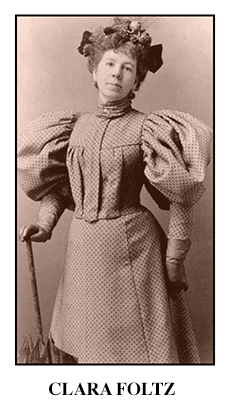 In 1894, Ms. Foltz took an interest in the Martin will case and urged members Portia Club to attend the trial. This attracted the attention of other women who turned out in droves. Few trials had ever played to packed houses, and none had so many women in attendance. After awhile, a larger venue was needed. In 1894, Ms. Foltz took an interest in the Martin will case and urged members Portia Club to attend the trial. This attracted the attention of other women who turned out in droves. Few trials had ever played to packed houses, and none had so many women in attendance. After awhile, a larger venue was needed.
What attracted many spectators was the scandalous nature of the testimony against Isabella J. Martin (aka Mrs. John Martin). The trial often resembled theater, and some in the audience reacted with laughter, gasps or applause, which, of course, did not please Judge James V. Coffey, who was moved to make several derogatory remarks about women, because he blamed their presence for turning the trial into a melodrama.
This caused a rift between Ms. Foltz and Judge Coffey, which was explained in “Woman Lawyer: The Trials of Clara Foltz,” a book by Barbara Babcock, the Stanford University law professor, not the actress. |
In addition to lectures and lessons at Foltz’s office, the Portia Club regularly attended court trials — a movement tactic pioneered by the San Francisco suffragists.
Twenty years earlier, they had made headlines with a mass turnout for the trial of Laura Fair for shooting Alexander Crittenden, a distinguished lawyer and her adulterous lover.
Their point then was to protest her judgment by an all-male jury and to relieve the heavily male atmosphere of the courtroom. Clara Foltz agreed with the need for women to attend court in order to support the woman litigant, whose situation she described to the Portia Club: "faced by a male judge, flanked by a male jury, surrounded by male lawyers . . . with a male clerk and bailiff and a mob of male bipeds in the lobby. . . . A woman, especially if she is a timid one, is at a terrible disadvantage in such a place."
|
|
The will case gave Portia Club members the opportunity to experience Mrs. Isabella J. Martin, a woman who definitely was not timid, but whose behavior did not help her case. Mrs. Martin's lead attorney was Grove Johnson, who'd worked with Ms. Foltz several years earlier to push a bill through the California state assembly. The "Woman Lawyer Bill" was a landmark 1878 California legislative act that changed the state law requirement for practicing law from "any white male citizen" to "any citizen or person," paving the way for women to become attorneys in California and across the West Coast.
|
Now he (Johnson) was a rich and successful railroad attorney, though he continued to support political equality for women — his last progressive cause.
Delphin Delmas was Mrs. Henry Martin’s lawyer. Born in France, educated at Santa Clara University and Yale, Delmas was the best-known lawyer in the West.
The two men were in their fifties, at the top of their form, 'two intellectual giants, both brilliant, both learned, both scholars, both struggling for the mastery in an almost even contest," as Foltz told the Portia Club.
In appearance, Johnson was a dandy, with highly polished leather boots to the knee, a frock coat, and fresh boutonnière. His hair and beard were long and carefully tended.
Delmas was balding and clean-shaven, rumpled and unprepossessing, his elegant speech a contrast to his exterior.
In style, Johnson was forceful, almost fierce at times; Delmas was more polished and painstakingly prepared.
For three months, the case was tried before large crowds that the (San Francisco) Call described as made up of 'lawyers and women.'
|
|
The trial not only was scandalous — mostly at the expense of Mrs. John Martin, who was exposed as a blackmailer and an adulteress — but often chaotic. Documents disappeared from the clerk's office; some were found, but witnesses or lawyers would claim changes had been made in the documents. Mrs. John Martin was sent home one day to retrieve an important piece of evidence that somehow she had in her possession.
Lawyers frequently ignored the judge's rulings, and the trial definitely was more about Mrs. John Martin's past than the validity of the will she had submitted. That will would leave one-third of her brother-in-law's estate to "Baby John," the boy she had brought back from New York City in 1891, claiming she had given birth in a Manhattan hotel and that the boy was legitimate because her husband was the father.
Opposing Isabella Martin, usually referred to during the case as "Mrs. John," was May Martin, or Mrs. Henry Martin. The will she submitted left her all of her husband's estate. When the case finally went to the jury, Mrs. Henry Martin prevailed.
The salacious nature of the questions raised about Mrs. John Martin, her behavior in court, and the presence of so many women to hear the testimony and witness the spectacle discombobulated the judge, whose comments about women during the trial irked Ms. Foltz and members of the Portia Club. |
The verdict did nothing to settle a dispute over court attendance by women between Clara Foltz and the presiding judge that had come to a head in the last weeks of the trial.
James V. Coffey, presiding judge of the probate court, had a reputation for being calm and judicious, but the Martin case tested his patience. Battered by the two powerful advocates, each willing to risk citation for contempt to make his case, he was also upset by the women spectators who filled virtually all the seats and made him uncomfortable in his own courtroom.
The Portia Club members behaved appropriately, but other women spectators were not under Foltz’s tutelage and did not understand what was expected of a courtroom audience.
At one point, the jurors complained that the women were “constantly making comments about the evidence.” Even when silent, they expressed themselves by “the most contemptuous smiles and head shakes.”
If the entertainment value lagged, they whispered and even dozed.
While the potentially scandalous testimony of Mrs. John Martin was pending after Delmas called her as a witness, the judge warned: "I would advise the ladies, and those of lady-like quality, not to attend court for the next few days though they can, if they insist, exercise their rights as American citizens, but I think ladies will hardly come here."
The women took his advice for a day or two during the legal arguments leading up to the testimony, but they were back in force when Mrs. John Martin took the stand. Women out of control, his courtroom out of control, Judge Coffey gave a press interview excoriating females as clients and court spectators. He did not limit his angry litany to Mrs. John Martin; all women clients were suspicious, unreliable, unreasonable, and ungrateful.
|
|
The judge said the women spectators were "vulgar-minded" for attending the trial even though, in the judge's opinion, the testimony wasn't fit for them to hear.
Upset by the judge's remarks, Ms. Foltz arranged a special Portia Club event at the St. Nicholas Hotel. It amounted to a roast of Judge Coffey, to which the public and the press were invited. |
Foltz opened by observing that three types of men took the normal “badinage, wit and raillery” between the sexes too far: young ignorant men, old bitter men, or “bachelors who never had a soul big enough to capture the heart of a loving woman.”
The reference was obvious; Judge Coffey was forty-eight years old and had never married. She added that he was especially unqualified to talk about female clients since a search of the court records showed that he had represented only one woman in his whole career as a private lawyer.
By contrast, Foltz said she herself had more than three hundred women clients, and she testified that, with the exception of two who had mental problems, they were all exemplary. Continuing the personal attack, she mocked the judge’s previous career, portraying him as occupying a desk in a lawyer’s office, but since no clients came to him, not actually practicing at all.
Most seriously, Foltz found the judge too prejudiced to preside in cases in which women were concerned. She suggested that if he had made the same remarks about Germans that he had about women, no German person would wish to appear before him.
Finally, she said that since women were involved in many cases as witnesses and litigants, Judge Coffey should probably give up presiding and “confine himself to the clerical work of the probate department, for which he seems well fitted.”
|
|
Unfortunately for Isabella J. Martin, she did not follow Ms. Foltz's example in expressing her grievances with the several judicial enemies she would make over the next 14 years. Ms. Foltz used words as her weapons, but Mrs. Martin eventually decided in favor of dynamite.
|
|