| Home |
 |
 |
|
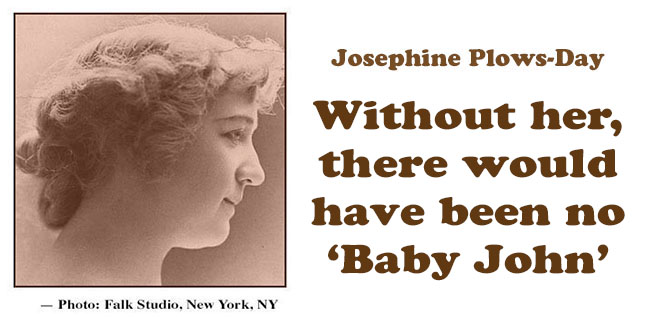
Before there was Farrah Fawcett-Majors and Meredith Baxter-Birney, there was Josephine Plows-Day. Unlike those other two, Plows-Day kept the last name of the man she'd married long after she left him. Like those other two, Plows-Day was an actress; at least, she was for a few years before the found another calling. What does Josephine Plows-Day have to do with Isabella Bidwell Hoffman Martin? Quite a bit, actually. To me, the surprising thing about the sensational 1894 Henry Martin will trial is how little attention was given to the actress without whom there might not have been a trial since she was the person who arranged for Mrs. Martin to buy the baby who was at the center of the case. It was like the reporter for the San Francisco Call, the newspaper from which I gathered most of my information about the trial, had never heard of the woman — even though, four years earlier, a Call columnist noticed her and had this to say: "Actresses have queer ideas about their bill names. The fashion now seems to run in the direction of oddity. Thus a girl who played with Mansfield lately is billed as Josephine Plows-Day." Richard Mansfield was a well-known German-born English actor-manager acclaimed for performances in Shakespeare plays, Gilbert and Sullivan operas, and the play, "Dr. Jekyll and Mr. Hyde." (His performances in the last one made such an impression that briefly he was accused of being Jack the Ripper.) Josephine Plows-Day played opposite Mansfield for a while, went on to tour with Henry E. Dixey, one of the most popular comedy performers of his time (and one of Ms. Plows-Day's lovers), and also worked on stage opposite the very successful James O'Neill (father of Eugene O'Neill) in one of his biggest hits, "The Count of Monte Cristo." A name-dropper could have a field day with Plows-Day's career connections. A reviewer for the Brooklyn Daily Eagle (March 8, 1892) wrote this about a performance of “The Solicitor,” a three-act farce that was playing locally: Despite an occasional bad review, Ms. Plows-Day was doing quite well as an actress until 1894 when she abruptly left the country. HOW AND WHEN Josephine Plows-Day met Isabella Martin is unknown; it might have happened when Isabella, as she often did, attended a play and went backstage. The women had much in common — both were quite attractive as teenagers and as young adults; both married soon after finishing high school; both were flirtatious and unfaithful wives, and both liked to perform. Though ten years younger than Isabella Martin, Josephine Plows-Day probably served as a role model, perhaps inspiring Mrs. Martin to do what she attempted after the will trial (the subject of Part 3). However, the strongest connection between the two women was "Baby John." Ms. Plows-Day had an interest in orphans and unwanted babies, and it was she who arranged for Isabella Martin to buy a baby in May, 1891. The actress brought the baby to Isabella's New York City hotel suite and helped prepare a scene that made it look as though Isabella had given birth. (Despite their depositions, Dr. Valzah and a nurse were not present when the baby arrived. They conveniently arrived after Ms. Plows-Day had, like a stork, delivered the infant.) It was not long after she gave a deposition claiming "Baby John" was Isabella Martin's child that Ms. Plows-Day left the play, "The Prodigal Daughter, citing ill health, and hopped aboard a liner named Teutonic and sailed for Europe where she remained for years. During the Martin will trial, Josephine Plows-Day was in Paris. Though I've found nothing that indicates this is true, I can't help but wonder if Ms. Plows-Day anticipated legal problems as a result of her involvement in the fraud Isabella Martin had hatched when she claimed she was the biological mother of a child entitled to one-third of Henry Martin's will. THE ACTRESS was no stranger to unconventional behavior and controversy. Her family seemed to specialize in it, though for several years, when she was a child, her father, William James Plows (shortened from Plowers) ran a successful distillery, providing an upscale life for his wife and their several children. William James Plowers and Olivia Pierce were married in 1852 in New York state, and moved west, living for awhile in Milwaukee before settling in Chicago. However, fourteen children later, their marriage fell apart. I found this interesting newspaper story on the findagrave.com page for Olivia Pierce Plows. There is no indication of the name of the newspaper or the date of publication, but it is almost certainly from the Chicago Times or the Chicago Tribune in 1879 or early 1880. |
|
|
|
Among the very interesting things in that article is William Plows' weekly salary. The man couldn't have been too down and out, despite his drinking, because $200 a week was an excellent income in 1880. I believe the oldest child, her name spelled Lividell in the 1870 census, was baptized Olivia Dell. And the third child, listed above a Lalla Rookh, was identified as Gertrude in the 1870 census. ("Lalla Rookh" is an 1817 romantic work by Irish poet Thomas Moore. The title refers to the tale’s fictional heroine. Lalla Rookh means "tulip-cheeked" or "rosy-cheeked." In any event, Gertrude Lalla Rookh Plows married very well. Her husband Henry H. Knowles was an executive with the Equitable Life Assurance Company, and they lived in New Orleans and Atlanta before moving to New York City. But more about Gertrude later. Josephine also used marriage to escape a home situation that became extremely unpleasant during and after her parents' divorce. Her husband's name was Frank. H. Day. However, after a few years, Josephine became bored at being Mrs. Day. |
|
|
|
Josephine and the love-struck Mr. Prindiville thought they were eloping and would live happily ever after in Europe, but they already were married to other people, so cooler heads prevailed. Prindiville returned to his wife and children in Chicago; Frank Day divorced Josephine, and she went to New York City to become an actress. In 1893, the New York Press ran this brief biography of the woman: |
|
|
|
| Nowhere during that Southern tour did Miss Plows-Day make a bigger hit than in Atlanta. | |
|
|
One reason she was popular in Atlanta was her sister, Mrs. Henry Knowles, wife of the insurance company executive. Mr. and Mrs. Knowles lived for awhile in Atlanta. Tragedy awaited Mrs. Knowles, whose name was more unusual than the one carried by her sister, the actress. Mrs. Knowles was born Gertrude Lalla Rookh Plows, and her mother preferred to call her Lalla Rookh. By 1898, she must have had an interesting arrangement with her husband, because Lalla Rookh seldom was home. She loved to travel, and in the spring of that year, she visited her mother in Chicago. While in Chicago, she was badly injured in what was called a runaway accident, which I assume involved a horse that got spooked while pulling a carriage. This delayed her departure from Chicago, but instead of going to Buffalo, New York, to rejoin her husband, she and her daughter, Gertrude, 12, went to New York City to board the French steamship, La Bourgogne, headed for Le Havre. From there she'd go to Paris where sister Martha was waiting. According to the Chicago Tribune (July 8, 1898), Mrs. Knowles told her mother of a premonition. "I should not be surprised if the vessel should sink as the result of a collision in mid-ocean." La Bourgogne did not get the far. It was off Sable Island, not far from Nova Scotia, when the ship collided with an iron-hulled ship called Cromartyshire, bound for Philadelphia. Mrs. Knowles, her daughter and 560 other persons died in what was the most disastrous Atlantic Ocean sinking until the Titanic 14 years later. HOWEVER, that wasn't the only tragedy that struck Josephine Plows-Day's family in the 1890s. In 1893, there were two events that may have been instrumental in the woman's decision to chuck acting and find something else to do with her life. |
|
|
|
On the same day that this story appeared, it was announced in the New York Dramatic Mirror that Josephine Plows-Day had been signed by James O'Neill to play leading roles in his productions of "Monte Cristo" and "Fontenelle." Two weeks later Miss Plows-Day was getting good reviews for her performance in Boston with James O'Neill in "Fontenelle," while her siblings made headlines in the Chicago Times (May 20, 1893) for a family feud. The newspaper called the suicide of Olivia Plows and the attempted suicide of her sister, Mercedes, "one of the strange events in the history of a family that has furnished many sensations." Mercedes had gone to New York where two older sisters, Martha Plows and Lalla Rookh Knowles, and her father, William, were living. Martha wrote a letter that was signed by the other three members of the family and it was sent to the Chicago City Press Association. In that letter, they blamed Edward Plows for the problems that led sisters Olivia and Mercedes to decide life was no longer worth living. "His career from early manhood has been a dishonest and disgraceful one," the letter said about the 38-year-old candy manufacturer. The newspaper story said, "The letter states that reverses having come to the Plows family, these young girls attempted to earn an honest livelihood and repeatedly applied to their brother for employment in his candy store, whereupon he advised them to 'Go upon the street — you’re devilishly pretty — and get a lover to support you.' The letter even blamed Edward for destroying their parents' marriage, an accusation that seems ridiculous in view of the mother's statements when she asked for a divorce (in the story shown earlier). The letter claimed that while the wealthy Edward was lavishing thousands of dollars on a woman who wasn't his wife, he gave his mother only $10 per month for the support of herself and the two daughters who still lived with her. The newspaper contacted Edward, who dismissed the letter as a collection of lies. He and sisters Martha and Lalla hadn't gotten along in many years. Of his father, Edward said he was living in New York because "Chicago became too hot for him several years ago." He also said he'd been very supportive of sister Mercedes, who was 15 years old. "I paid out $600 for her to bring her through after that trouble, besides other expenses ... I was the only friend she had." He said he wasn't surprised at the statements by his two older sisters, adding that he had letters from them saying they would ruin his business. A day after this story was published, the New York Press (May 21, 1893) carried a brief biography of Josephine Plows-Day, charting her rapid rise as one of the most successful young actresses, and predicting that "next season she will achieve another important step upward in her career." She certainly was going over big in Boston. |
|
|
|
| But six months later, tragedy struck again. | |
|
|
Four weeks later, Josephine Plows-Day left the cast of "The Prodigal Daughter," claiming ill health, then sailed for Europe on the ocean liner Teutonic, saying she would probably remain abroad for at least a year. Oh, about Edward Plows and that remark his sisters made that he spent thousands of dollars on another man's wife. It seems Chicago favorite confectionist led an interesting life. |
|
|
|
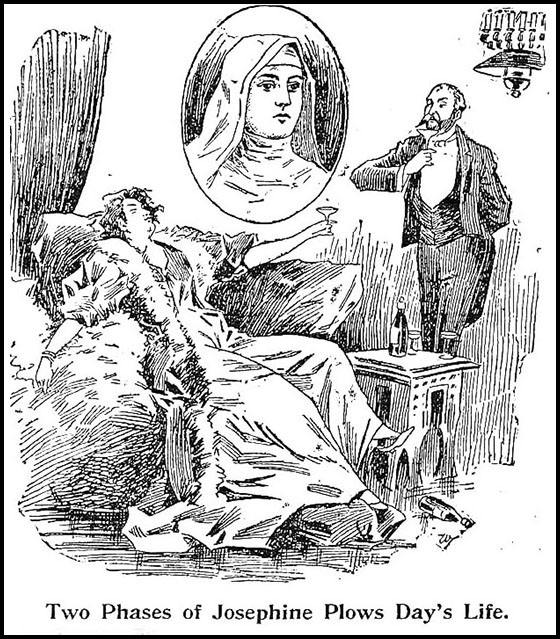
Now back to Josephine Plows-Day, who was about to turn her life upside down. She was in Paris in 1894 while her friend, Isabella Martin, was having her reputation shredded during the sensational will trial. But later, when Mrs. Martin tried to become an actress, Miss Plows-Day left Paris and went to London and became active in missionary work among the city's poor. By 1897, some folks back in the United States got to wondering whatever happened to that actress with the unusual name, and two magazine-length stories appeared in American newspapers in 1897. The stories were similar and, I suppose, could have been written by the same person. Whoever wrote them must have been paid by word, because hundreds of them were used, but they provided precious little information about the woman's new life. One of the stories appeared with this illustration: |
|
 |
|
| — illustration from Elmira Telegram, September 26, 1897 | |
| The story in the Elmira Telegram began like this: | |
|
|
On and on and on the story went, saying much the same thing over and over again, the writer working the Aphis angle to death while never mentioning how Miss Plows-Day supported herself, except to hint that during the time she spent in Paris she attracted and exploited rich men. Two weeks earlier, another story about the former actress appeared in the New York World. It began like this: |
|
|
|
Search for Josephine Plows-Day online and the results are interesting. You'll discover she was nicknamed "Tippy" and she seems to have been four women in one: The first was an apparently successful stage actress who had a promising future, but walked away in 1894 and, for awhile, seemed to disappear. The second was a woman who became active in social reform and child welfare, getting involved in foundations that helped find homes for abandoned babies, this time on the up and up. To honor her youngest sister, she founded the Mercedes rescue work in London in 1911. Her third woman was named in the unusual 1925 will of New York City educator Clara B. Spence, who requested that Miss Plows-Day, along with Louise Miller and Louise McElroy, run the prestigious Miss Spence's School. How long she remained at Miss Spence's School, I do not know, but she later returned to England where she was head of the National Adoption Society of London. As far as her fourth incarnation, well, according to Google's AI Overview, Josephine Plows-Day also was a figure in avant-garde and literary circles. She was the aunt of Gladys Tilden, the romantic partner of modernist writer and editor Margaret Anderson. Anderson wrote a lesbian novel, “Forbidden Fires,” described as a veiled account of her unrequited longing for Josephine Plows-Day, identified in this source as "an English actress," though she was strictly a Chicago girl who, so far as I've been able to determine, didn't perform on stage after she left New York City in 1894. Also, so far as I know, Miss Plows-Day was strictly heterosexual, 24 years older than Anderson, and at the time of their meeting may have become an Episcopalian nun. She died in 1958 and there are conflicting stories about where her death occurred. It was either in London or at the Convent of St. Anne in Arlington, Massachusetts. For sure she is buried in a private cemetery at the convent. (Her obituary suggested contributions to the Josephine Plows-Day Scholarship Fund.) Weird to think what happened after she and Isabella Martin crossed paths to commit fraud. Miss Plows-Day wound up in a convent; Mrs. Martin was sentenced to life in prison. |
|
| HOME • CONTACT | |