| Home |
 |
Isabella Martin, Part 2 |
||
 |
||
However, that didn't stop Isabella from hatching a plot against May Martin, and it was revealed four months after Henry Martin died: |
||
|
||
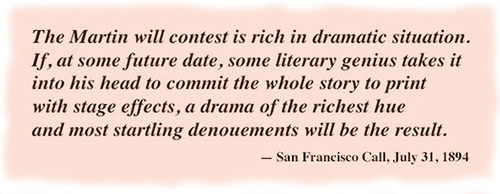
The newspaper described the new will as being very short and badly written. "The will bears no signature of witnesses, but is holographic." (A holographic document was one written entirely by hand by the person who signed it.) Things became stranger a few days later when the first will — in which Henry Martin left all of his property to his wife — was reported stolen from the Trinity County clerk's office. Since that will had been copied and duly recorded in the books of the probate court, no one knew what a thief hoped to gain by stealing the original. FOR MAY MARTIN, it was time to act. She went public with her suspicion John Martin had been poisoned by Isabella. Most residents of Weaverville felt the same way, so Trinity County authorities decided to exhume John Martin's body so an autopsy could be performed by Dr. W. D. Johnston of the San Francisco's Cooper Medical College (which would become the Stanford University School of Medicine). But when that was done, Dr. Johnston said he found no trace of arsenic in John Martin's corpse. That satisfied Isabella Martin, but not the Trinity County coroner's jury which ruled John Martin did not die from natural causes. The jury was disappointed in Dr. Johnston's report and wondered why the doctor hadn't looked for other poisons. Thus May Martin and many residents of Weaverville remained convinced Isabella had caused her husband's death. Despite May Martin's belief her brother-in-law had disinherited Isabella, such a will was never found and the widow inherited his estate (about $40,000). Now she wanted a chunk of brother-in-law Henry's estate for her mystery child, John Bidwell Martin ("Baby John"), born in 1891. Thus California was treated to the war of the widows, a court case unlike any that had gone before. There was much interest even before the case went to trial because one widow was suspected of murdering her husband. The other had been socially prominent even before she married Henry Martin when she was Mrs. Samuel Moore (or More, as it often appears), a San Francisco wholesale liquor merchant. Also, word was leaked that the trial would reveal Isabella's scandalous past. HAD TELEVISION existed in the 1890s, both Isabella and May Martin might have been regulars on "The Real Housewives of San Francisco." At the time, both were considered attractive. Isabella Martin was colorful and combative, May Martin was cool and let her lawyers do the fighting. For the former Mary "May" Blunt, the frosting on the cake was a story published in the San Francisco Call shortly after Henry Martin's death. By today's standards, there's something creepy about how May was groomed, but in 1893 this was regarded as a moving, very romantic tale |
||
|
||
CLEARLY, Henry Martin's widow was the heroine in the upcoming trial, while Isabella Hoffman Martin was the wicked witch. At issue: the validity of the second will. This would be decided by a jury. A very patient jury, it turned out. May Martin assembled a dream team of lawyers to prove her case, but Isabella Martin's abrasiveness was an attorney repellent. The case was supposed to begin on May 7, 1894, but Mrs. John, as she'd be called during the trial, was without a lawyer. And no wonder: |
||
|
||
Isabella Martin managed to secure one of the state's most prominent attorneys, Grove Lawrence Johnson of Sacramento. Johnson did not like nor trust Isabella Martin, but may actually have believed the second will was valid. He would make a tremendous effort to win the case for the person he insisted was his only client — "Baby John." Further, Johnson, who had served in the state senate and assembly, was a candidate for the U. S. House of Representative in 1894. He may have anticipated the wide coverage the trial would receive and felt the publicity would help his political campaign. (He was right — in November he was elected to Congress.) FINALLY, on July 9, the will case began and soon turned into a mud-slinging contest that drew standing room only crowds, forcing Judge James V. Coffey to find the largest room possible for the proceedings. Isabella Martin had inherited about $40,000 from husband John, and was willing to gamble a chunk of it in an effort to grab one-third of her brother-in-law's estate valued at between $200,000 and $300,000. And even if that inheritance were awarded to "Baby John," it would be controlled for many years by Isabella, who wasn't exactly the most devoted mother. (More on that later.) If she came out the loser in this case, Isabella Martin would have to rely on income from rental properties she inherited from her husband. (She already was proving to be the landlady from hell, involved in several lawsuits involving tenants. She'd soon find it more convenient to torch the buildings and collect the insurance, but that's a matter for part four, the conclusion of the Isabella Martin story.) As for Clara Foltz, mentioned in the story above, she was California's first female attorney, and, to some extent, a role model for Isabella Martin, though that didn't mean Mrs. Martin, as a client, would treat Mrs. Foltz differently than she had other lawyers. Still, Clara Foltz was lucky. She got wise to Mrs. Martin very early, and dropped her as a client before the will case, though Mrs. Foltz's presence would be felt during the will trial, which was attended more by women than men, probably a first in this country. |
||
NO FEWER than nine lawyers were involved in the will case, five for May Martin. With Grove Johnson aboard on the other side, three other lawyers agreed to assist, though they'd all regret being associated with Isabella Martin. May Martin's chief attorney was Delphin Delmas, who, because of a physical resemblance, was called "The Napoleon of California." (His fame would go national 13 years later when he defended Harry Thaw for the Another lawyer on May Martin's team was Arthur Rodgers. To many, he was the best attorney on the case, so it was clear Grove L. Johnson was in for the legal fight of his life. He would receive no gratitude from the woman who hired him. That was partly because Johnson felt his chance of winning the case depended on minimizing Isabella Martin's role. He felt she would antagonize the jury as much as she angered lawyers. However, his strategy wound up antagonizing Isabella even more. However, the woman would not be denied, and she became the central figure in the trial, much to Johnson's dismay. And it was because of Isabella that the trial became San Francisco's best show from July through September. Fittingly, the trial unfolded much like a stage play. |
||
|
||
Perhaps another judge would have reined in the lawyers at that point. After all, the only question to be answered involved the validity of the second will, but Delmas, Rodgers and company also wanted to prove there was no way Henry Martin would leave anything to a child he believed was not his real nephew. While alive, Martin had told many people he thought Isabella Martin had gone to New York City in 1891 and purchased the boy from an agency for foundlings. And while Judge Coffey was reluctant to admit the evidence submitted by May Martin's attorneys, he eventually would yield on almost every point after several prolonged legal arguments that kept the trial going much longer than anyone anticipated. |
||
|
||
In preparing for the trial, Isabella Martin had gone to New York City to obtain depositions from six people who'd seen her while she was there in 1891. Among the six was Dr. Van Valzah. In his deposition, Dr. Van Valzah said Isabella was an old acquaintance and he described the circumstances of the birth, adding that Mrs. Rose Larkin of Brooklyn also was present and acted as nurse. (Coincidentally — and not surprisingly — the doctor also stated Isabella had not yet paid his bill, amounting to $180.) Attorney Delmas believed this and the other depositions of the New York witnesses were false. And when Delmas finally convinced the judge to allow the reading of the so-called "Crawford letters," which dealt with a baby Isabella supposedly had in 1885, when she was between marriages, the case got turned upside down. That's when it became "The Isabella Hoffman Martin Show," which prompted one of her lawyers to quit in mid-trial and forced Grove Johnson to make a closing argument that was the courtroom equivalent of a "Hail Mary" pass. |
||
|
||
Isabella Martin wanted to defend herself, but Grove Johnson refused to call her to the witness stand. That didn't stop her. She contacted the San Francisco Call, said she wanted to talk, and an interview was arranged. During the interview, Mrs. Martin accused two of her lawyers of improper behavior toward her. The article was published on the morning of August 16. In the courtroom, before the trial resumed that day, one of those lawyers, Crittenden S. Thornton, announced he was quitting and he urged Grove Johnson to do the same. General William Henry Linow Barnes, a Civil War veteran, was the other lawyer mentioned in the article, He had parted ways with Mrs. Martin before the trial, but he came to the courtroom on August 16 just before the noon recess so that he could make a statement with the judge present, but the jury and spectators absent. He denied an impropriety with Isabella Martin; she apologized and came as close as she ever would to admitting she had lied. As for Grove Johnson, he refused to quit, making it clear he was working on behalf of "Baby John," not the boy's mother, a woman he admitted he did not like. The lawyer maintained the position that the case was all about the child, and that Isabella Martin had no part in it. Delmas and May Martin's other lawyers knew the opposite was true, which is why Delmas called upon Isabella Martin to testify, which is what she wanted. Afterward, Johnson correctly claimed, "They put Mrs. John Martin on the stand solely to impeach her, solely to torture her, solely that they might throw mud at her." When questioned, Isabella gave as good as she got most of the time. She certainly was the trial's most entertaining witness: |
||
|
||
| Isabella's undoing might have been another batch of letters, those supposedly written to her by Henry Martin. These were called the "Dear Belle" letters and were as phony as the second will. Grove Johnson may have believed they were real; it certainly seemed so when he finally got around to making his melodramatic closing argument. But first ... | ||
|
||
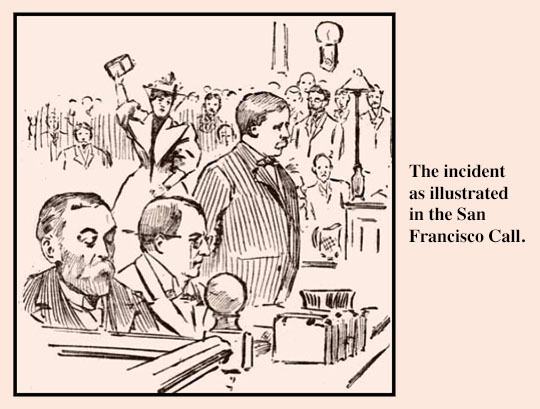
| There were times during the trial that Isabella's anger was real. She made several outbursts even while she was seated with her lawyers, and one of them made for the trial's most memorable incident: | ||
|
||
Ten days later, San Francisco Examiner said what many were thinking: "When Grove L. Johnson took up his argument (yesterday) for “Baby John” Martin before the jury in Judge Coffey’s court, people who had followed the trial wondered what he would be able to do with a hopeless case." What he did was deliver a performance worthy of an acting award, but its impact was short-lived, wilting in the days that followed in the face of a critique offered by Delphin Delmas, who had the last word in the case. |
||
|
||
It didn't take much time for the jury to announce its agreement with Delmas, though two members sided with Isabella Martin. However, a unanimous vote wasn't required, and Henry Martin's widow emerged victorious. Isabella made it known she would appeal the verdict. Isabella Martin's behavior during the trial undoubtedly turned some jurors against her, and probably made them put more trust in May Martin's witnesses. Particularly damaging was testimony Edward Casserly, deputy county clerk, who said Isabella Martin came to the office two days after the filing of the original will, asked for the will, and sat down to make a copy of it. Shortly thereafter, she announced she had discovered a second will made out by Henry Martin. Those ten jurors who declared the second will a forgery also must have agreed with Delmas that Isabella Martin also forged the February 23, 1893 "Dear Belle" letter while the trial was in progress. No effort was made to punish Isabella Martin for forgery, and for years after she unsuccessfully tried to have the judgment overturned and another trial ordered. She did manage to delay payment of the inheritance to her sister-in-law. |
||
| Also worth mentioning . . . | ||
» Attorneys Delmas, Rodgers and Johnson all battled colds during the trial, affecting their ability to speak. Johnson's cold was particularly nasty, causing him to have coughing fits. A month into the trial, Isabella Martin also became sick and was absent from court for a few days. » Isabella Martin wasn't the only one who misbehaved. Grove Johnson's sharp tongue sometimes led him to the brink of a fistfight. For example, he believed court clerk Neely Murphy not only misplaced those depositions on purpose, but was responsible for leaking inappropriate information to the press. One day while the judge momentarily left the courtroom, Johnson made some comments to Murphy, and the clerk suggested the two men step outside to settle things. Another incident involved William S. Craig, a member of May Martin's legal team, who spoke with a Southern accent. Whenever he was called upon to question witnesses, Johnson would poke fun at Craig for his "Confederate manners." One day Craig accused Johnson of saying something that was insulting to his witness. That led to this exchange: Johnson: "I have not said so but if I wanted to say so I should have done so regardless of your Confederate manners, sir." Craig: "My Confederate manners can take care of themselves, and I'm ready at any time to defend them." Judge Coffey intervened to restore order. » Those in attendance on July 30 were entertained by an exchange while attorney Delmas cross-examined Mrs. Jennie Tibbetts, who ran a boarding house where Isabella Martin lived after her husband died. Mrs. Tibbetts testified Henry Martin often visited the widow. |
||
|
||
Mrs. Tibbetts (often spelled Tibbets) was Isabella Martin's key witness, claiming Henry Martin came to her boarding house on February 24, 1893 to deliver a "Dear Belle" letter that accompanied the second will which was written a day earlier. Isabella Martin was asleep at the time, said Mrs. Tibbetts, so she put the papers in a drawer — then conveniently forgot all about them for several weeks before informing Mrs. Martin of Henry Martin's visit that evening. Accompanying the will was the key "Dear Belle" letter. This made for a good story, though it was hard to believe, for several reasons. Delmas and Rodgers had witnesses who swore Henry Martin was so sick on February 24 that he did not leave his bed, much less his apartment at the Palace Hotel. And since he died three days later, it was unlikely had he visited the Tibbetts place. It was just as unlikely the landlady would have forgotten Henry Martin's visit and his note and not said anything to Isabella Martin for several weeks. OTHER trial tidbits: » The forged will was interesting, the way Isabella asked for only one-third of the estate and tried to win the support of Henry's two surviving siblings by including them. However, it turned out one of the siblings, William Martin, who lived in Maine, didn't need nor expect anything from his much younger brother. He smelled a rat and suspected John's widow, Isabella, from day one. His views were made known during the trial. » Grove Johnson obviously didn't want the jury to know Isabella was the daughter of a Bidwell, since that also was also the last name of two notorious forgers. So he objected when Delmas asked Isabella for her maiden name and the judge sustained the objection. However, it was no secret the child at the heart of the case was named John Bidwell Martin. » Proceedings were interrupted during the afternoon of August 6 when it was learned that a juror's house was on fire and he was allowed to leave. » On July 24, James Bowie, sheriff of Weaverville, told of how on one occasion Mrs. John Martin sent for him to arrest her husband. “ 'He’s beaten me,' she cried. I asked her, 'Why, how are you going to get any one to believe that John Martin would do a thing like that?' Mrs. Martin replied: 'I don’t care. He’s an Irish brute and he did beat me. I stood on the stairs with a pistol and if he’d come up I’d shot him.' " Grove Johnson objected, and the Bowie's tale was stricken from the record. » Henry Martin's widow, May, testified that she brought a private fortune of $150,000 into the marriage, which was almost twice as much as her husband had at the time. If that was correct, most of the money up for grabs in the disputed will was hers to begin with. » On July 26, Morris M. Estee, Republican candidate for Governor, testified he overheard Henry Martin refer to his sister-in-law as an adventuress and said she was a blight on his brother, John. Six weeks later, on the day of the book-throwing incident, Mrs. Martin boarded a street car and found Estee by her side when she sat down. “I probably did, but I don’t know who you are,” answered Estee, undaunted. “I am Mrs. John Martin,” she responded. “I did not say you were, but I testified that Henry Martin said you were,” was Estee’s answer. “Who you are and what you are I do not know.” That silenced her. » An interesting witness was Thomas Coster, a coachman who said on two occasions he had driven Isabella Martin and Henry Martin in his carriage, indicating the relationship between them was much friendlier than May Martin's witnesses had testified. But what was most interesting was that Coster and his wife, Annie, had taken care of "Baby John" for the past 22 months — while his mother lived elsewhere. Coster said Mrs. Martin owned him and his wife $600 and she claimed she had no money to pay them. » On August 1, Grove Johnson was told that the six depositions Isabella Martin had obtained from six New York City witnesses were missing. Johnson suspected court clerk Neely Murphy was responsible. Eight days later they were found in a drawer belonging to a clerk of another court. » In her deposition, Isabella Martin said she was 34 years old, shaving eight years off her actual age. » On August 7, there was an issue raised by clerk Neely Murphy over money he was owed for services. He demanded $265 from Mr. Pond on behalf of Mrs. Henry Martin and $469 from Mrs. John Martin’s side. “If these are not paid," he said, “I won’t swear a witness.” » A day later a suit was filed against Isabella by Dr. Winslow Anderson who claimed she still owed him $209 for services performed two years ago. » After court proceedings on Friday, August 10, Isabella Martin was so upset that two days later, she tracked down court stenographer Sam Sumner and accused him of falsifying his record of the trial in an effort to make her look bad. Sumner was so rattled that when Mrs. Martin was back in the witness chair when the trial resumed, Sumners left the courtroom, claiming he was ill. » In Isabella's deposition, she claimed she'd given birth to "Baby John" on May 5, 1891 between eight and nine o'clock in the morning. Questioned by attorney Arthur Rodgers during the trial, she said she'd given birth between eight and nine o'clock in the evening. » On August 21, she was questioned by attorney Delmas and proved very stubborn. “How many children did you say you had in your time?” inquired Delmas. Told by the judge that wasn't a proper answer, she said she'd had three children born alive, twins born dead. Delmas tried to prove that if she did give birth to three children, the third was born in Philadelphia in 1885, not in New York City in 1891. » On August 27, five jurors were late, delaying the start of the day's proceedings. “I won’t have this,” shouted Judge Coffey. “These jurymen complain to me that they are pressed for time, and that they are kept waiting every day. I won’t have it. I’ll fine ’em each a dollar a minute.” “I’ll have to go to jail, your honor,” said Cody. “I haven’t the five.” » A burly San Francisco policeman was assigned to keep Isabella Martin in check. He wasn't always successful, obviously. On September 21, Henry Hoffman, Mrs. Martin’s 18-year-old son, asked the district attorney to have the policeman removed. » The three-year-old boy at the heart of the case was often in court in the care of a nurse. Reporters covering the trial noted his presence and said the boy was surprisingly well behaved, considering he had to endure hours of testimony that probably meant nothing to him. The San Francisco Call several times mentioned the boy's "laughing blue eyes." It was the boy's eyes that may have helped convince Henry Martin and later his widow's lawyers that he was not the son of Isabella and John Martin. That's because newspaper accounts were wrong — the boy's eyes weren't blue. This fact wasn't mentioned until Arthur Rodgers' closing argument, when he declared, "This brown-eyed child of a blue-eyed race is not Henry Martin's child." Years later a reporter for the Oakland Tribune, covering a trial involving 17-year-old "Baby John," would write, "His complexion is swarthy, but there is a harmony between it and his raven hair which showed a lineage having origin in one of the Latin countries." » During legal arguments over the relevance of the Crawford letters, Isabella left her seat and stomped out of the courtroom. It was hours later that she contacted the San Francisco Call to set up an interview. » Grove Johnson had something in common with our 47th president — he sometimes dozed off during a witness's testimony. This was especially true when the witness was a handwriting expert called by the other side. » Johnson would serve only one term in Congress, but his son Hiram, 28-years-old at the time of the trial, would be governor of California from 1911 through March 15, 1917, and a United States Senator from March 16, 1917 until his death on August 6, 1945. » Isabella was particularly upset with handwriting expert Peter D. Horton because she'd asked him to testify on her behalf and he told her he couldn't because she wouldn't like what he had to say. She apparently thought they'd made a deal, and her anger built to a point that late in the trial, she and her son, Henry Hoffman, paid Horton an unusual visit. » Isabella also was angry with Johnson for calling "Baby John" the sinless child of sin. "I refuse to pay a man who slandered my child," she told reporters. » Johnson's associate, Walter H. Linforth, told a reporter Isabella Martin had promised him $1,000 — $5,000 more if the case had been won — but he did not receive a cent. » Tragedy struck handwriting expert Augustus H. Breckenfeld. He committed suicide a few days after he finished testifying. Breckenfeld's wife, who had been ailing for some time, passed away and he decided he could not live without her and he shot himself in the head. » Isabella Bidwell Hoffman Martin unsuccessfully appealed the verdict and was just as unsuccessful when she sued Ms. Henry Martin for $750,000 for damages allegedly done to her character and standing in the community by the defendant. Isabella claimed that not only was Henry Martin in love with her, but that she had known May Martin's first husband, Samuel Moore, and that he was infatuated with her. » There might not have been a will case if it weren't for an interesting stage actress who had a special interest in finding homes for foundlings. As May Martin's lawyers suspected, Isabella Martin bought "Baby John," a transaction arranged for her by Josephine Plows-Day. » A loser in court, Isabella Martin hoped to be a winner on stage. As for "Baby John," he would be back in the spotlight, but not until 1908 in another sensational trial. This time he and Isabella would be on opposite sides. |
||
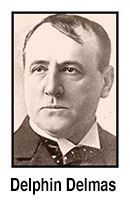 murder of architect Stanford White for his relationship with Mrs. Thaw — Evelyn Nesbit. This was the case dramatized in the 1955 film, "The Girl in the Red Velvet Swing.")



 For many, the climax was the best part of the trial, While the other attorneys also presented closing arguments, they were warm-up acts for Grove Johnson and Delphin Delmas, the star attractions. Both men took two days to complete their arguments.
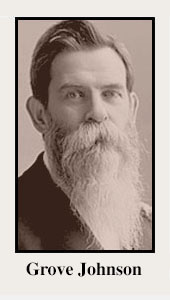 (September 24,, 1894) reported Johnson's words had some jury members in tears. As he neared the end of his remarks, Johnson dropped to his knees and made this rather strange appeal:
| Part one: Belle, the butcher's daughter |
| Part three: Start spreading the news |
| Part four: Fire in the hole! |
| HOME | CONTACT |